

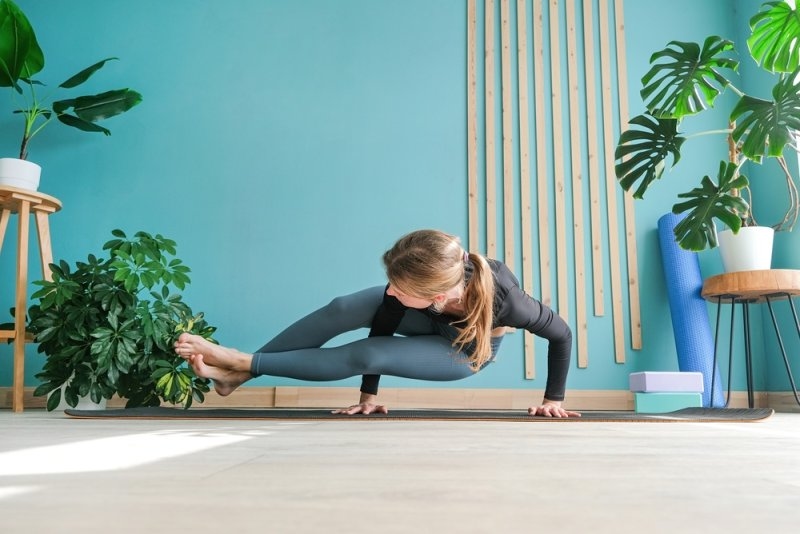
Astavakrasana is an advanced Yoga Pose that challenges you by combining strength, flexibility, balance, and focus. The Asymmetrical Arm Balance is sometimes called Eight Angle Pose, a complex Yoga Pose which involves draping a leg over an arm before crossing ankles, lifting your hips, and extending legs off to a side while hands support your entire body.
Astavakrasana is an asymmetrical arm balance that shifts a substantial amount of weight onto the arms and demands flexibility in the hips. This intense Yoga Pose works to strengthen arms, shoulders, core, wrists, hips, and inner thighs simultaneously.
The name comes from the sage Astavakra, as it represents a bent-over form. This demanding and integrated shape is often reserved for those who have developed foundational Yoga Exercises.
Read More: How to Perfect Mountain Pose for Stability and Alignment
Here’s how you can practice this eight angle pose easily:
An important warm-up focusing on strengthening the wrists, shoulders, hips, hamstrings, and core is essential. Cat-cow, various hip openers, leg lunges, or even some variations of poses like plank can further condition your body and muscles to support the complex mechanics of this posture and weight transfer.
Find a sitting position with legs extended and bend one knee toward your torso. Tuck your entire thigh onto your right upper arm and press palms onto the floor, parallel to the outsides of your hips. Cross your ankles and point your feet in opposite directions, away from your center, as you ground yourself on your hands and shift shoulders forward while pushing hip strength away from your body.
You can finally lift your hips away from the ground as you breathe calmly into this position, and eventually begin to extend legs to one side.
These complementary Yoga Exercises will enable you to successfully incorporate the individual actions required to move into Eight Angle Pose more fluidly, and over time become one with the full posture.
Trying to force your hips up will create leverage issues and put more strain on the wrists than needed; the secret is creating solid contact from your outer bicep through your fingers as you push your whole body weight from your hands away. Avoid collapsing in the chest when leaning forward; activate your shoulders.
The extension into the crossed legs isn't all about leg straightening; it's crucial to maintain connection at the bent leg that's resting over the arms. Keep the bent leg firmly planted to build the necessary leverage while activating inner thighs and engaging your feet by point of feet.
Place your bicep against your femur and practice drawing your knee toward your torso. After lifting the hip off the ground, simply continue bending the knees if you still aren't flexible enough. The goal here is getting used to feeling how much control and engagement this takes without overwhelming yourself with the shape itself.
Place your hands upon two blocks to raise your foundation a little higher, creating space and time for perfect weight shift while holding the leg pose.
Astavakrasana calls many muscle groups into action-arms and shoulders bearing the weight, core holding it together, inner thighs and hips gripping on for support. The balancing required to perform it helps the body improve body awareness as well as coordination skills due to extremely small shifts in weight necessary to keep one’s hips lifted properly.
This yoga pose, while advanced, builds a tremendous amount of confidence to explore further into arm balance yoga.
Since they bring the body's total weight to the hands, advanced Yoga Exercises should always be approached with awareness. Perform this posture with an engaged and controlled mind as you activate your muscles, and be sure to pay attention if your body feels tired or you're experiencing unusual discomfort (if that is the case, simply modify or skip for the moment!). Always do the following:
Rather than continuously returning to full Ashtavakrasana during your practice time, build individual portions of the posture. Try to refine the weight distribution throughout your palms, practice leg attachment until this is comfortable and automatic, lift the hips from your strength at this point without considering leg extension, and the rest will naturally fall into place.
This movement takes a lot of concentration-focus on steady breath flow through the pose! Make sure to breathe consciously so your alignment is solid; in this stance, the pose is actually not quite possible otherwise. A controlled five-breath posture is infinitely more productive and safer than a shaky ten.
Astavakrasana is quite a demanding shape that truly integrates flexibility, strength, coordination, stability, and concentration. Practiced in balance with progressive Yoga Exercises that focus on appropriate form, you can attain the ability to attempt this pose in a more relaxed state than previously thought.
Learning Ashtavakrasana doesn't have to mean mastery within a single try; building balance, creating power, and taking an eased but confident stride toward Arm Balance Yoga is part of the challenge and gift of Yoga!
Astavakrasana is generally considered an advanced yoga pose since the pose demands significant levels of control and activation in the arms, core, hips, and balance. This pose is best approached through simple yoga exercises rather than attempting the entire pose right from the start.
While you shouldn’t hold the pose for more than a few breaths initially to make sure the pose feels comfortable and your alignment and breathing are stable, gradually increase your hold with consistent alignment and control over a longer holding period.
You will want comfortable hip mobility for Astavakrasana, as your leg would want to travel high up onto the arms. However, tight hips are secondary compared to a lack of control and stability in your arms, core, and a strong sense of balance.
Your hips will not lift away from the floor if you lack sufficient forward movement of body weight, strong enough hands, shoulders, or core control. Practice the supported shift of body weight and beginner-level poses as a stepping stone to mastering the movement of your hips lifting off.
Yes, arm-balancing poses engage mindful balance and control over the entire body in terms of strength and weight distribution, so a consistent practice can bring increased body awareness and coordination to your practice, further developing strength that you might need for more complex balancing postures.
This content was created by AI